A New Way to Donate: School-Level Giving
Donors could only support schools with an active teacher project, leaving most schools invisible. We created a way to give directly to any U.S. public school—and opened an entirely new acquisition channel for DonorsChoose.
+17% new-donor conversion
+25% map conversion
+40% average donation

My role
Product strategy, opportunity framing, prioritization, design direction, and executive alignment
Team
Product management, design, engineering, and operations
The Challenge
DonorsChoose is the leading classroom fundraising platform in the US, having raised over $1.8 billion for teachers in 90% of all public schools. Yet despite this massive reach, a core limitation remained: at any given time, only around 17% of schools had an active fundraising request from a teacher—meaning donors couldn’t give to the vast majority of public schools we serve, even if they wanted to.
This disconnect hurt donor conversion, especially among new users searching for specific schools. Our existing model—where teachers must register and create time-bound fundraising requests—was limiting our ability to match donor intent with giving opportunities.
The Hypothesis
What if we could allow donors to give to every public school in the US, even when no teacher was actively fundraising? Could this unlock more giving opportunities, improve conversion, and also help us to activate new teachers? We believed it could—but we needed to test whether this idea was viable, desirable, and scalable.
We launched a tightly scoped MVP to explore:
- Whether school-level giving would increase donor conversion
- Whether this would be net-new revenue or cannibalize existing donations
- Whether funds sent to schools could be effectively redeemed and used by teachers
But you don't have to take my word for it...
“Dan consistently brought a disciplined and rigorous approach to product prioritization and evaluating revenue impact.”
We focused on a few main use cases: users searching for specific schools on our site, using our map feature to discover local giving opportunities, and organic school search traffic through search engines. Although we had existing school landing pages, they were previously de-emphasized since they led to donation dead-ends. This pilot flipped that model.
Execution
Our cross-functional team shipped new functionality to:
- Enable donations directly to school pages
- Surface these schools in key user flows like site search and map results
- Send and track gift codes so that new-to-DonorsChoose teachers could get classroom supplies with these donations
Since this was a low-volume pilot, we used manual processes to disburse funds—outreach to active teachers and, where needed, school principals—to validate our hypothesis before scaling.
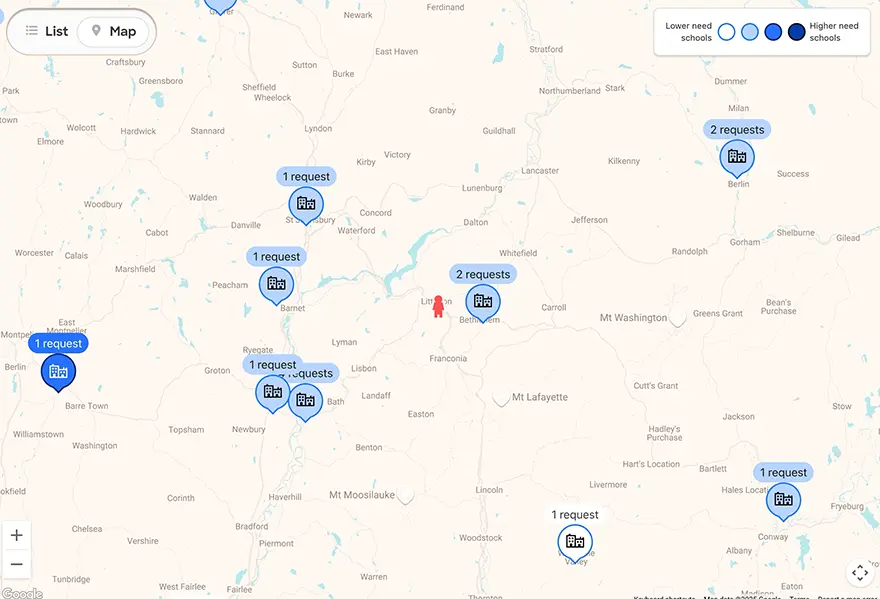
Say you wanted to support local schools in your hometown: Littleton, NH. When you searched for Littleton on the map, you’d get a zoomed out view of neighboring towns. The closest school you can support is your arch-rival in Bethlehem! There is no way to support schools in your town. Frustrated, you hurl your laptop across the room.
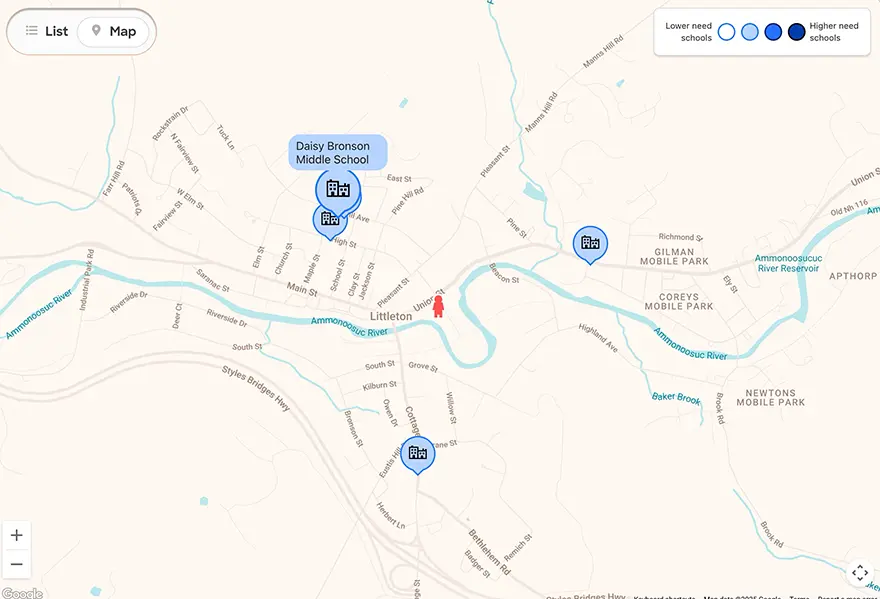
With the introduction of this new feature, a search for Littleton yields all of the public schools in Littleton, ready to accept donations! Now you can give to Daisy Bronson Middle School, just as you had hoped! Laptop remains unhurled.
This is just an illustration of one of the many use cases for donors who benefited from this new feature. Most of the effort was deep, behind-the-scenes work to collect the money and distribute it to the schools the donor intended.
Results
The pilot was a resounding success across all key metrics:
- +17% new donor conversion: Donors who previously bounced found a meaningful way to give. This unlocked new acquisition opportunities.
- +25% map conversion: Our map, already a key discovery tool, became dramatically more effective when it included all schools—not just ones with live projects.
- +40% average donation size: School-level gifts averaged $110, much larger than the average classroom project donation.
We also learned a lot about areas we needed to smooth over in the next iteration:
- 64% redemption rate: The majority of new-to-DC teachers were able to redeem their school gift codes, but we still saw room for improvement here. One of our post-pilot projects is to experiment here and figure out how to drive this number up.
The Outcome
After analyzing the pilot results, we invested in a v2 that fully integrated School-Level Giving into the DonorsChoose ecosystem. It’s now a core part of how we connect donors with public schools—and a strategic lever for both donor acquisition and teacher engagement.
It’s hard to overstate how rare it is to unlock a win of this magnitude on a platform as mature as DonorsChoose. This wasn’t a flashy pivot or a shortcut—it was the result of deep user understanding, disciplined experimentation, and an extraordinary cross-functional team. The impact was worth every bit of the care, rigor, and collaboration we put into it.
I led the talented team of PMs, designers, and engineers who brought this project to life. My role was in identifying the opportunity, shaping the strategy, and guiding the work from concept through launch. I led prioritization, collaborated on design direction, defined success metrics, and secured executive buy-in. The impact was only possible thanks to the creativity and thoughtful execution of the team.
Next case study:
Ideas are easy, implementation is hard
Implementation is my specialty. Want to build together? Reach out.